
Scientists find new frog species that disguises itself as poop
The quirky amphibian joins four other new species of frogs uncovered in Papua New Guinea by Australian scientists.


By Dean Murray via SWNS
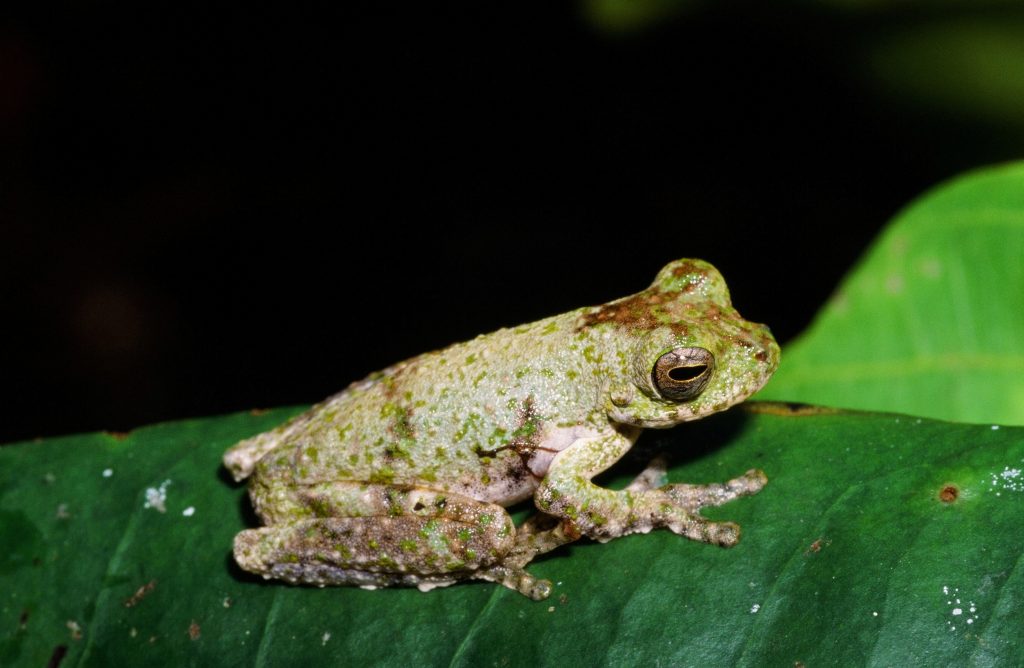
Scientists have discovered a new frog species - that disguises itself as poop.
A new study describes Litoria naispela as being camouflaged to look like bird droppings in order to ward off hungry predators.
The quirky amphibian joins four other new species of frogs uncovered in Papua New Guinea by Australian scientists.
Researchers from the South Australian Museum, Queensland Museum and Griffith University located the frogs in "very wet mountain forest areas" along the central mountain range of New Guinea.

The five new species are named Litoria daraiensis, Litoria gracilis, Litoria haematogaster, Litoria lisae and Litoria naispela.
The five frogs were collected over 30 years by lead author South Australian Museum Honorary Researcher Dr. Steve Richards.
“I spent a huge amount of time waiting at night beside tree holes in rain, hail and (moon)shine, for frogs to emerge in order to find these amazing species, and to try and learn about their biology,” Richards said.
“New Guinea has more species of frogs than any other island in the world and most are found nowhere else."
”New discoveries like this show that this richness of species is also matched by a diverse set of ways to make a living as frog.”
Queensland Museum scientist Dr. Paul Oliver, a joint appointee with Griffith University said the new species highlight the remarkable and poorly understood diversity of New Guinea frogs.
“These small tree frogs lay their eggs out of the water, typically on leaves, quite different to your typical treefrog, which lay their eggs directly into water,” Dr. Oliver said.
“Tadpoles of one new species, Litoria naispela actually live in water collected in tree hollows, a behavior not previously documented in frogs from New Guinea.”
“Litoria naispela also has juveniles that have color and patterning that closely resembles bird droppings – we think this is a form of defensive masquerade.”

South Australian Museum Acting Director Justine van Mourik acknowledged the vital role museums play in exploring and describing Australia’s biodiversity.
“Amphibian populations are in decline globally and there is still so much to learn about Australia’s amphibian biodiversity,” Ms van Mourik said.
“Through the important work of our taxonomists, we are continuing to discover species, learn the vital role they play within our natural environments and better understand how we can protect these amazing species now and into the future.”
The new paper was published recently in Zootaxa.
Stories and infographics by ‘Talker Research’ are available & ready to use. Stories and videos by ‘Talker News’ are managed by Talker Inc. For queries, please submit an inquiry via our contact form.





Giant tortoise population thriving as 180,000 found on one island
This is the highest figure ever recorded for the species and far exceeds the human population of the Seychelles.

Three arrested after missing cat’s severed tail found in owners’ mailbox
All three were arrested on suspicion of malicious communications and failing to prevent the causing of unnecessary suffering to an...


Working around men makes women feel worse about mistakes: study
Women are likelier than men to perceive mistakes more negatively – depending on with whom they are sharing a workspace.


Simple formula could predict when AI chatbots will go ‘rogue’
"Until now, nobody could say when that flip would happen."


‘Extraordinary’ signal from space provides new insight into early universe
Some experts have suggested they may be from an extraterrestrial lifeform trying to contact Earth.

 Studies2 days ago
Statin users less likely to need stronger treatment for glaucoma

 Sports4 days ago
Over a third of fans actually believe their rituals affect the game

 Uncategorized3 days ago
‘Super ice’ 10 times stronger, bends instead of shattering

 Music3 days ago
David Bowie’s ‘lifetime’ ban from venue lifted posthumously
 Animals1 day ago
Do dog owners who share beds with their pets sleep more soundly?

 Work3 days ago
Seasonal workers need this much to make ends meet this holiday season

 Health2 days ago
Can bird-watching help stroke survivors speak again?
- Tech9 hours ago
Simple formula could predict when AI chatbots will go ‘rogue’
