
New implant detects and reverses overdoses automatically
The opioid epidemic currently claims more than 70,000 lives each year in the United States.


By Stephen Beech via SWNS
A new implant could slash the number of deaths from drug overdoses, say scientists.
The device successfully delivered naloxone - a medicine that rapidly reverses an opioid overdose - when it sensed a drop in breathing respiration during tests on animals.
Now American researchers are evolving the technology while also looking for industry partners in preparation for deployment on a larger scale and testing of the device in human clinical trials.
They say it could eventually be used to help people who suffer from epilepsy or are threatened by other medical conditions, such as anaphylaxis.
The opioid epidemic currently claims more than 70,000 lives each year in the United States, and doctors say lifesaving interventions are urgently needed.
Although naloxone, sold as an over-the-counter nasal spray or injectable, saves lives by quickly restoring normal breathing during an overdose, administrating the medication requires a knowledgeable bystander – limiting its lifesaving potential.
A team from Washington University School of Medicine in St. Louis and Northwestern University in Chicago has developed a device that may save people from overdosing without help.

(Joanna Ciatti and Jihun Park via SWNS)
Results of animal studies, published in the journal Science Advances, show that the implant detects an overdose, rapidly delivers naloxone to prevent death and can also alert emergency first responders.
Professor Robert Gereau, of Washington University Medicine Pain Center, said: “Naloxone has saved many lives.
“But during an overdose, people are often alone and unable to realize they are overdosing.
"If someone else is present, they need access to naloxone - also known as Narcan - and need to know how to use it within minutes.
"We identified an opportunity to save more lives by developing a device that quickly administers naloxone to at-risk individuals without human intervention.”
He says prescription opioids – such as oxycodone – have helped people manage the physical and mental challenges of daily debilitating pain.
However, the addictive properties of painkillers can lead to their misuse and abuse, which are among the driving forces behind the opioid epidemic.
Cheap and easy-to-access synthetic substances - such as fentanyl – have also flooded the illicit drugs market in the US.
Experts say such "ultrapotent" drugs have accelerated the rise in overdose deaths in the U.S. and were responsible for roughly 70% of those deaths in 2023.
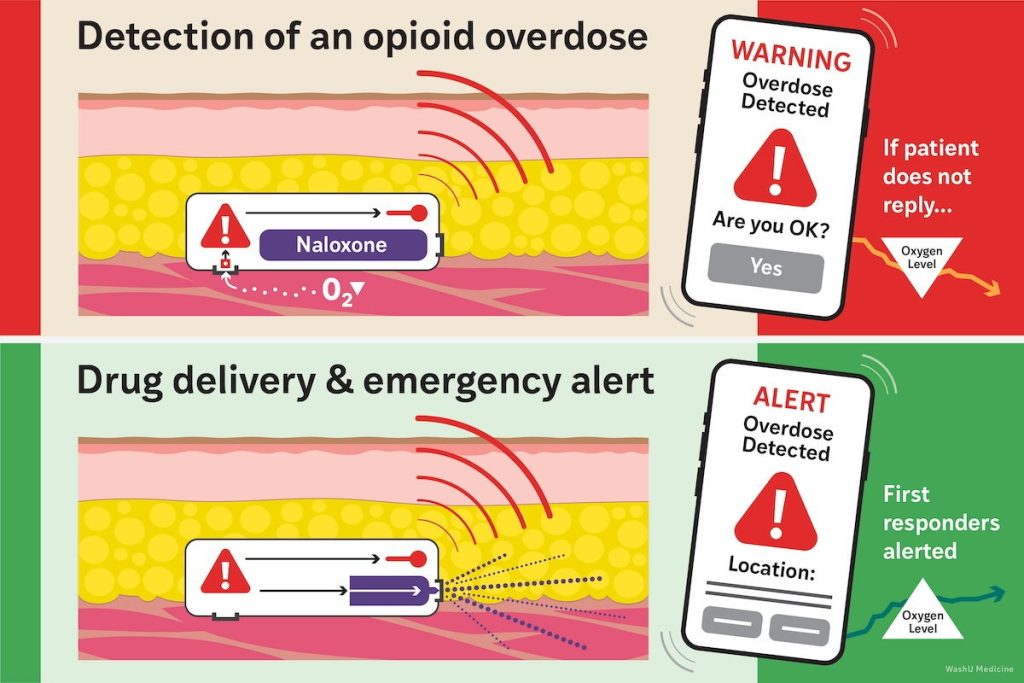
The research team worked with experts in engineering and material sciences to develop the device - called the Naloximeter - that uses a drop in oxygen levels as a signal for a potential overdose.
(Eric Young via SWNS)
Overdosing on opioids leads to slow and shallow breathing. Minutes after the drugs begin to impact respiratory function, breathing stops.
Implanted under the skin, the Naloximeter senses oxygen in the surrounding tissues, sending a warning notification to a mobile app if the levels drop below a certain threshold.
If the user doesn’t abort the rescue process within 30 seconds, the device releases stored naloxone.
The research team implanted the device in the neck, chest or back of small and large animals.
The device detected signs of overdose within a minute of dropping oxygen levels, and all animals fully recovered within five minutes of receiving naloxone from the devices.
Scientists explained that Naloxone displaces harmful opioids from receptors on the surface of brain cells, altering the cells’ activity.
But the drug doesn’t stick around; when the opioids reoccupy and reactivate the receptors, overdose symptoms can return.
To provide additional support, the device relays an emergency alert to first responders.
Study co-author Professor Jose Moron-Concepcion, also of Washington University School of Medicine, said: “An additional benefit of calling first responders is that it helps people re-engage with health-care providers.
“We want to save people from dying from an overdose and also reduce harm from opioids by helping people access the resources and treatments to prevent future overdoses from occurring.”
The research team were awarded a patent to protect the intellectual property of the device.
Now they are preparing for human trials.
Joanna Ciatti, who was part of the team at Northwestern University, said: “The Naloximeter is a proof-of-concept platform that isn’t limited to the opioid crisis.
“This technology has far-reaching implications for those threatened by other emergent medical conditions such as anaphylaxis or epilepsy."
She added: "Our study lays important groundwork for future clinical translation.
"We hope others in the field can build off of these findings to help make autonomous rescue devices a reality.”
Stories and infographics by ‘Talker Research’ are available & ready to use. Stories and videos by ‘Talker News’ are managed by Talker Inc. For queries, please submit an inquiry via our contact form.







Vaping around kids raises asthma risk just as much as smoking
Exposure to e-cigarettes at home is as bad as tobacco smoke for asthma patients, according to a study.


Animals may have evolved 200 million years earlier than thought
The research team says their findings could transform understanding of one of evolution's greatest mysteries.

Underwater umbrellas could protect coral reefs from heat damage
High sea temperatures driven by global warming damage coral reefs, bleaching them ghostly white and eventually killing them.


X and Y chromosomes shape how cells age and fight disease too
A new study brings together growing evidence that the X and Y chromosomes do much more than just determine biological...


Rescuers save raccoon after head gets stuck in tin can
Rescuers applied lubricant around the can’s opening and slowly removed the raccoon's head.

 Science4 days ago
Scientists find ‘switch’ to potentially unlock longer lifespans

 Outer Space5 days ago
NASA reaches milestone toward Artemis III Moon mission

 Travel5 days ago
Travel mishaps cost average traveler nearly $2,500

 Work4 days ago
Over half of Americans don’t think social media is a real job

 Food & Drink4 days ago
Brew-haha? Americans secretly judge coffee orders

 Life3 days ago
Is it time to retire ‘sexy’ Halloween costumes?

 Outer Space3 days ago
Astronaut shares shirtless ISS photos from medical research
 Life5 days ago
Record 622-pound bluefin tuna caught off British coast
