
Volcanoes set off chain of events that brought Black Death to Europe
Clues contained in tree rings have identified volcanic activity as the "first domino to fall" in a sequence that led to the bubonic plague.


By Stephen Beech
Volcanic eruptions set off a chain of events that brought the Black Death to Europe, according to new research.
Clues contained in tree rings have identified 14th Century volcanic activity as the "first domino to fall" in a sequence that led to the devastating spread of bubonic plague.
Researchers used climate data and documentary evidence to paint the most complete picture to date of the "perfect storm" that led to the deaths of tens of millions of people, as well as massive economic, political and cultural changes.
Their evidence suggests that a volcanic eruption – or cluster of eruptions – around 1345 caused annual temperatures to drop for consecutive years due to the haze from volcanic ash and gases.
That in turn caused crops to fail across the Mediterranean region.
To avoid riots or starvation, the research team say Italian city states used their connections to trade with grain producers around the Black Sea.
The climate-driven change in long-distance trade routes helped avoid famine, but as well as vital food supplies, the ships carried the deadly bacterium that ultimately caused the Black Death.

The study, by researchers at Cambridge University and the Leibniz Institute for the History and Culture of Eastern Europe (GWZO) in Germany, is the first time that it has been possible to obtain high-quality natural and historical data to draw a direct line between climate, agriculture, trade and the origins of the plague.
Between 1347 and 1353, the Black Plague killed millions of people across Europe with the mortality rate close to 60% in some areas.
While it is accepted that the disease was caused by the bacterium Yersinia pestis, which originated from wild rodents in central Asia and reached Europe via the Black Sea region, it’s still unclear why the plague broke out when it did and how it spread so quickly.
Cambridge geography Professor Ulf Büntgen said: “This is something I’ve wanted to understand for a long time.
"What were the drivers of the onset and transmission of the Black Death, and how unusual were they?
"Why did it happen at this exact time and place in European history? It’s such an interesting question, but it’s one no one can answer alone.”
Prof Büntgen, whose research group uses information stored in tree rings to reconstruct past climate variability, worked with Dr. Martin Bauch, a historian of medieval climate and epidemiology at GWZO, on the study published in the journal Communications Earth and Environment.

Dr. Bauch said: “We looked into the period before the Black Death with regard to food security systems and recurring famines, which was important to put the situation after 1345 in context.
“We wanted to look at the climate, environmental and economic factors together, so we could more fully understand what triggered the onset of the second plague pandemic in Europe.”
The researchers combined climate data and written documentary evidence with conceptual reinterpretations of the connections between humans and climate to show that a volcanic eruption – or series of eruptions – around 1345 was likely the first step in a sequence that led to the Black Death.
The researchers were able to approximate this eruption through information contained in tree rings from the Spanish Pyrenees.
Consecutive "Blue Rings" pointed to unusually cold and wet summers in 1345, 1346 and 1347 across much of southern Europe.
While a single cold year is not uncommon, the researchers said consecutive cold summers are highly unusual.
Documentary evidence from the same period noted unusual cloudiness and dark lunar eclipses, also suggesting volcanic activity.

The volcanically forced climatic downturn led to poor harvests, crop failure and famine.
But the Italian maritime republics of Venice, Genoa and Pisa were able to import grain from the Mongols of the Golden Horde around the Sea of Azov in 1347.
Dr. Bauch said: “For more than a century, these powerful Italian city states had established long-distance trade routes across the Mediterranean and the Black Sea, allowing them to activate a highly efficient system to prevent starvation.
“But ultimately, these would inadvertently lead to a far bigger catastrophe.”
Previous research has suggested that ships carrying the grain probably also carried fleas infected with Yersinia pestis.
Ancient DNA has suggested that there may have been a natural reservoir of the deadly bacterium in wild gerbils somewhere in central Asia.
Once the plague-infected fleas arrived in Mediterranean ports on grain ships, the researchers say they became a "vector" for disease transmission, enabling the bacterium to jump from mammalian hosts to humans.
Büntgen said: “In so many European towns and cities you can find some evidence of the Black Death, almost 800 years later.

“Here in Cambridge for instance, Corpus Christi College was founded by townspeople after the plague devastated the local community.
"There are similar examples across much of the continent.”
Dr. Buach said: “We could also demonstrate that many Italian cities, even large ones like Milan and Rome, were most probably not affected by the Black Death, apparently because they did not need to import grain after 1345.
“The climate-famine-grain connection has potential for explaining other plague waves.”
The researchers say the "perfect storm" of climate, agricultural, societal and economic factors after 1345 that led to the Black Death can also be considered an early example of the consequences of globalisation.
Büntgen said: “Although the coincidence of factors that contributed to the Black Death seems rare, the probability of zoonotic diseases emerging under climate change and translating into pandemics is likely to increase in a globalised world.
“This is especially relevant given our recent experiences with COVID-19.”
The researchers say modern risk assessments should incorporate knowledge from historical examples of the interactions between climate, disease and society.
Stories and infographics by ‘Talker Research’ are available & ready to use. Stories and videos by ‘Talker News’ are managed by Talker Inc. For queries, please submit an inquiry via our contact form.


Man travels 1,300 miles to fish and catches ‘world record’ carp
The fisherman was left stunned when the giant carp took his bait.


Queen Elizabeth II’s hanky and Wallis Simpson’s toothpick for sale
The cotton handkerchief made for the then-Princess Elizabeth in the late 1940s is expected to fetch up to $670.
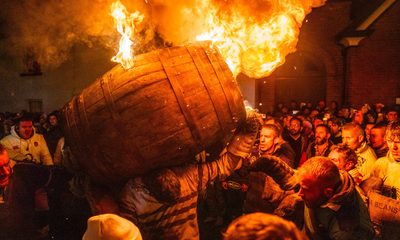

Fiery tradition has people carry burning tar barrels through streets
This flaming historic tradition is a blazing barrel spectacle.


Scientist fighting to keep badger he saved from starvation
“I just want the right decision made for Harriet.”


Beavers return to part of Scotland for first time in 500 years
Beavers are back in the famous part of Scotland 500 years after they were hunted to extinction.

 Studies4 days ago
Is living near too much noise bad for you?

 Food & Drink5 days ago
Energy drinks linked to serious heart issues in young adults

 Entertainment4 days ago
Original 1966 Batman No. 1 trading card sells for record price

 Holidays4 days ago
How are Americans giving holiday traditions makeovers?

 Money3 days ago
Six in 10 keep secret money from their partners

 Life2 days ago
Is the ‘morning debrief’ more essential than the night out?

 Weird4 days ago
Man who studied Loch Ness Monster for 50 years: It doesn’t exist

 Good News4 days ago
Adventurer ends 28-year walk around the world
