
New research reveals how lions and hyenas interact in the wild
Ecologists had long assumed that hyenas simply shadow lions for scraps.


By Stephen Beech
Lions track rival hyenas in the wild — rather than the other way round, reveals new research.
Scientists used GPS tracking technology to reveal what happens beyond human eyes deep in the bush during power struggles between the competing carnivores.
Ecologists had long assumed that hyenas simply shadow lions for scraps.
But the new study, published in the journal Frontiers in Ethology, shows that when they encounter each other it's the lions — especially males — that approach hyenas, and the hyenas that give way.
Researchers fitted GPS collars to 17 lions and 14 spotted hyenas living in the wild in Namibia and Botswana for the four-year study.
The technology allowed them to map the movements and real-time interactions of individual animals, revealing a hidden side to the rivalry between the competing species.
Study lead author Nancy Barker said: "During my Master's, I lived in the bush while studying brown hyenas.
"I repeatedly observed lions actively tracking hyenas.
"When I shared my observations with other leading researchers, I was often told that I had the relationship backwards: that hyenas are the ones tracking lions, primarily for scavenging opportunities, and that what I had seen was simply a series of chance encounters.
"I felt there was more to the story.

"Our GPS collar data shows that African lions and spotted hyenas leave a clear, measurable signature in the way they move around one another.
"Spotted hyenas consistently move away from lions, while male lions tend to move toward hyenas.
"Because the hyenas' retreat signal was consistent across three independent statistical tests, we can conclude that it reflects a repeatable behavioral pattern."
She explained that the balance of power seen in the wild is the result of thousands of individual decisions made by animals about risk and reward.
To track those decisions as closely as possible, Barker went to Etosha National Park in Namibia, and Chobe National Park and the adjoining Linyanti Conservancy in Botswana.
She said: "I spent several months simply learning the lions and hyenas, identifying the various lion and spotted hyena groups, understanding pride and clan dynamics and the areas they frequented.
"Over time I determined which individuals ranked higher on the social hierarchy.
"They were least likely to disperse from their pride or clan's territory, so I chose them for GPS collaring.
"We included collars from 17 lions and 14 spotted hyenas over four years for this study.
"Throughout, I maintained camera traps by day and conducted behavioral observations by night.
"People often imagine wildlife research as one exciting encounter after another, but the reality is very different."
Barker, from the University of KwaZulu-Natal in South Africa, used GPS fixes, taken every five minutes during the animals' peak activity hours, to map each animal's movements.
From that data, she identified 23 pairs of simultaneously tracked animals, including 10 lion-hyena pairs.
By classifying the direction of each individual's movements in each pair, the research team was able to identify and analyze thousands of interactions.
Barker say the observations provided context, for instance, by confirming that two closely associated lions were a mating pair.

She said: "For every moment when both a lion and a hyena had a GPS fix at the same time, we asked a simple question: was each animal moving toward the other, away from it, or off to the side?
"When repeated across thousands of simultaneous locations and many pairs of animals, a clear pattern emerges: hyenas are mostly moving away, whereas lions, especially the males, are mostly moving toward them."
Barker said the data also suggests that while male lions react to hyenas' presence by approaching them, females are more ambivalent.
During her observations, she noticed that male lions would actively track hyenas, while females reacted differently depending on which other pride members were present.
However, Barker cautioned that more data is needed to strengthen that finding.
She said: "Tracking this many large carnivores simultaneously is extraordinarily difficult, and we had a relatively small number of collared individuals.
"We also included only moments when both animals had a simultaneous GPS fix.
"This is the most rigorous approach, but it inevitably reduces the amount of data available for analysis.
"As a result, some of our finer-scale findings should be viewed as trends rather than firm conclusions."
Barker added: "If I had unlimited resources, I would love to extend this approach to other members of the carnivore guild, to understand how the entire community negotiates space and risk.
"Ultimately, I want to connect these movement patterns to what matters most for the animals: their survival and reproduction.
"The dream is to move from 'here is the behavior' to 'here is how this behavior shapes which animals thrive.'"
Stories and infographics by ‘Talker Research’ are available & ready to use. Stories and videos by ‘Talker News’ are managed by Talker Inc. For queries, please submit an inquiry via our contact form.







Billionaire wins approval for 40-acre solar farm at historic estate
The plans for the huge solar farm were initially met with criticism from both neighbors and the local parish council.


Do dog owners who share beds with their pets sleep more soundly?
The nighttime movements of humans and their dogs were found to be "strongly correlated" in new research.
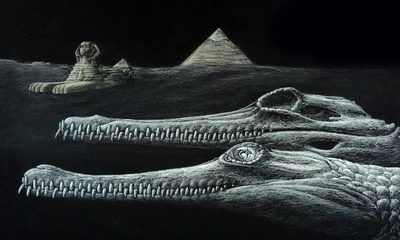

Ancient crocodile with missing snout named for Egyptian god
Scientists say Herugavialis cairensis was discovered in the same rocks used to build the Great Sphinx.


Bobcat returns to wild after being severely burned in California fire
The feline had first to third-degree burns across all four paws, acute kidney injury, severe emaciation and a heavy tick...

Thieves steal 1,000 pounds of grapes from vineyard
Award-winning Winbirri Vineyard produces Bacchus wine, often referred to as "England's Sauvignon Blanc," with an elderflower flavor.

 Studies1 day ago
Statin users less likely to need stronger treatment for glaucoma

 Sports2 days ago
Over a third of fans actually believe their rituals affect the game

 Uncategorized2 days ago
‘Super ice’ 10 times stronger, bends instead of shattering

 Work1 day ago
Seasonal workers need this much to make ends meet this holiday season

 Music2 days ago
David Bowie’s ‘lifetime’ ban from venue lifted posthumously

 Health1 day ago
Can bird-watching help stroke survivors speak again?

 Fashion & Beauty2 days ago
Guard gets modeling gig after going viral at London Fashion Week

 Weird2 days ago
Aerial photos reveal abandoned theme park reclaimed by nature
